
A token page can show a price to six decimal places and still leave users without the information they need to understand whether that number is useful. This problem is especially serious for smaller-liquidity assets, where a displayed reference price may differ materially from the price available for an actual trade.
The solution is not another promotional disclaimer hidden in a footer. Token pages need a compact, visible disclosure layer that explains how current the data is, how much market depth exists, what a trade may do to the price, and which project claims are live today.
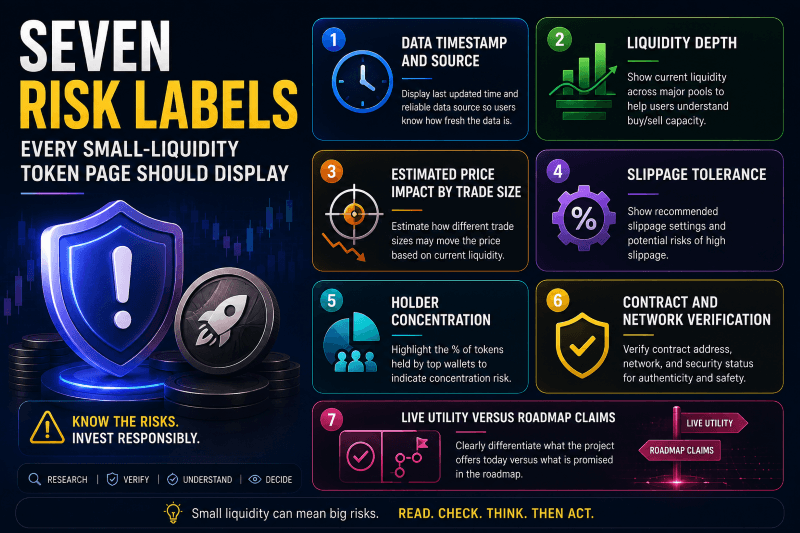
The following seven labels form a practical minimum. They do not tell anyone whether to buy or sell. They help readers distinguish observable market conditions from assumptions, estimates, and future plans.
1. Data Timestamp and Source
Every market number should answer two questions: when was it observed, and where did it come from?
A useful label might read:
“Price reference: last updated 14 seconds ago. Source: Raydium pool data via indexed market feed.”
The timestamp should reflect the age of the underlying market observation, not merely the time the page re-rendered. If a data provider is delayed, unavailable, or serving a cached value, the interface should say so. “Live” should never be used as a decorative word when the freshness of the data is unknown.
Pages that combine multiple feeds should identify whether the displayed value is an average, a last trade, a pool-derived quote, or another calculation. Different sources can produce different results because they observe different venues, pairs, routes, and update intervals.
A stale-data state should also be explicit:
“Market data is temporarily delayed. Do not treat this value as an executable quote.”
This label prevents false precision and gives users a reason to verify the current market before acting.
2. Liquidity Depth
A headline price says little about how easily an asset can be traded. Liquidity depth provides the missing context.
At minimum, a token page should identify the relevant pool or market, the paired asset, and a dated liquidity estimate. If the page reports total value locked or pooled liquidity, it should define exactly what is included.
A plain-language label could say:
“Limited liquidity: larger orders may move the market substantially. Liquidity estimate is based on the identified pool and may change quickly.”
Limited liquidity must not be marketed as automatic growth potential. It is a risk condition. Thin markets can amplify volatility in both directions, make execution less predictable, and increase the difference between a quoted reference price and the price a user actually receives.
When several pools exist, the page should either show them separately or explain how they were aggregated. Combining incompatible pairs into one large number can overstate the depth available for a particular route.
Also, Read Bitcoin Halving Explained: What Investors Need to Know
3. Estimated Price Impact by Trade Size
Price impact describes how much a proposed trade is expected to move the market because of the order itself. This is different from ordinary price movement occurring while the transaction is being prepared or confirmed.
A single generic warning is not enough. The interface should estimate impact for several example sizes relevant to the market. For example:
“Estimated price impact:
$50 trade: 0.4%
$250 trade: 2.1%
$1,000 trade: 9.8%”
These figures must be labelled as estimates and tied to the current route and pool state. They should update when the user changes trade direction, amount, pair, or route.
The interface should avoid presenting a calculation as a guarantee. Network conditions, competing transactions, routing changes, and rapidly changing liquidity can alter the final result. A clear note should explain that the estimate is based on current observable conditions and may differ at execution.
4. Slippage Tolerance
Slippage tolerance is the maximum unfavorable price movement a user permits before a swap should fail or revert. It is not the same as estimated price impact, even though both affect execution.
Token pages should define the term next to the control instead of assuming every visitor understands it. A good label might read:
“Slippage tolerance: the maximum adverse difference you accept between the displayed estimate and transaction execution. A higher tolerance may increase the risk of receiving a worse price.”
The interface should also explain that an extremely low tolerance can cause a transaction to fail, while an unnecessarily high tolerance can expose the user to avoidable execution risk.
Default values should not be treated as universally safe. Appropriate settings depend on liquidity, volatility, route complexity, network conditions, and transaction size. The page should show the selected percentage prominently before confirmation and calculate the minimum amount the user may receive.
5. Holder Concentration
Supply figures can be misleading without distribution context. A circulating-supply number may look large while a small number of wallets control a significant share.
A holder-concentration label should show the measurement date, the data source, and the methodology. At minimum, it can report the percentage held by the largest accounts, while clearly distinguishing known liquidity pools, treasury wallets, vesting contracts, burn addresses, exchanges, and unidentified wallets when that classification is verifiable.
For example:
“Top-10 concentration: 63% of observed supply as of [date]. Known pool and treasury accounts are identified separately where verified.”
Wallet ownership should not be inferred beyond the evidence. One entity can control many wallets, and one custodial wallet can represent many users. The label therefore describes account concentration, not guaranteed beneficial ownership.
On Solana, public RPC methods such as getTokenLargestAccounts and getTokenAccountBalance can support reproducible observations, but interpretation still requires care. The page should link to the mint address and explorer so readers can verify the underlying records.
6. Contract and Network Verification
Token identity is a security requirement, not a branding detail. Names and tickers can be copied. The network and contract or mint address are the reliable identifiers.
A verification panel should show:
- network;
- complete mint or contract address;
- copy button with visible confirmation;
- official explorer link;
- token standard;
- decimals;
- authority status when relevant and verifiable;
- last verification date.
The page should never shorten the address so aggressively that a reader cannot compare it meaningfully. A truncated version can be used for layout, but the complete value must remain available to copy and inspect.
If metadata differs across the project website, explorer, exchange, or market-data service, the page should warn readers rather than silently selecting the most convenient version. A clear identity label reduces the risk of confusion with imitation tokens.
Also, Read The Rise of AI-Powered Crypto Scams: How to Stay Safe
7. Live Utility Versus Roadmap Claims
A token page should separate what users can do now from what a team says it plans to build later.
“Live utility” should mean a user can perform the described action today through a functioning product or service. It should link to the relevant product surface and explain any access conditions. A roadmap item should be labelled as planned, experimental, in development, or dependent on an external integration.
Dates such as 2026 or 2027 should describe product work, integrations, or adoption milestones only when the project has published a basis for them. They must not be presented as price forecasts or implied returns.
A useful status model is:
- Live: publicly usable and verifiable.
- Beta: usable with disclosed limitations.
- In development: active work, not yet available.
- Planned: an intention, not a delivered capability.
- Paused or retired: no longer active.
This distinction protects readers from treating future claims as current facts and gives teams a disciplined way to update their own pages.
A Compact Pre-Trade Checklist
Before relying on a small-liquidity token page, a reader should be able to answer:
- How old is the market data, and what is its source?
- Which pool or venue provides the displayed liquidity?
- What is the estimated price impact for my trade size?
- What slippage tolerance is selected, and what is the minimum received?
- How concentrated are the largest token accounts?
- Have I verified the complete contract or mint address and network?
- Which utility claims are live, and which are only planned?
If the page cannot answer these questions, a precise-looking price is not enough.
Also, Read The Complete Beginner’s Guide to Cryptocurrency Investing in 2026
Disclosure Is Product Design
Good disclosure is not a legal paragraph added after the interface is finished. It is part of the product.
Small-liquidity markets can change quickly. The most responsible token pages make uncertainty visible, date their evidence, separate estimates from executable quotes, and explain how trade size affects outcomes. They do not turn limited liquidity into a promise of upside.
Seven concise risk labels cannot remove market risk. They can make the information environment more honest, testable, and useful.
Primary references:
- Uniswap Support, “Price Impact vs Price Slippage”:
https://support.uniswap.org/hc/en-us/articles/8643794102669-Price-Impact-vs-Price-Slippage - Solana RPC, getTokenLargestAccounts:
https://solana.com/docs/rpc/http/gettokenlargestaccounts - Solana RPC, getTokenAccountBalance:
https://solana.com/docs/rpc/http/gettokenaccountbalance
Author disclosure:
Mushegh Manukyan is affiliated with ARMCP_Team and has a direct professional interest in ARMCP Token. This article is educational and does not provide investment advice, a price forecast, or a recommendation to buy or sell any asset.
Author bio:
Mushegh Manukyan works with ARMCP_Team on a product-based Web3 ecosystem combining crypto information, market data, community publishing, and practical tools. His focus is translating token-utility claims and market data into clear, verifiable product disclosures for everyday users. Website: https://armcp.net/