

Bitcoin entered July 2026 in a mixed but important market phase. The price had already gone through a period of pressure, yet the month ended with a meaningful rebound rather than a confirmed trend reversal. For investors, that distinction matters. A rebound shows buyers are stepping in, but a true recovery only happens when price, volume, macro conditions, and market confidence all improve together.
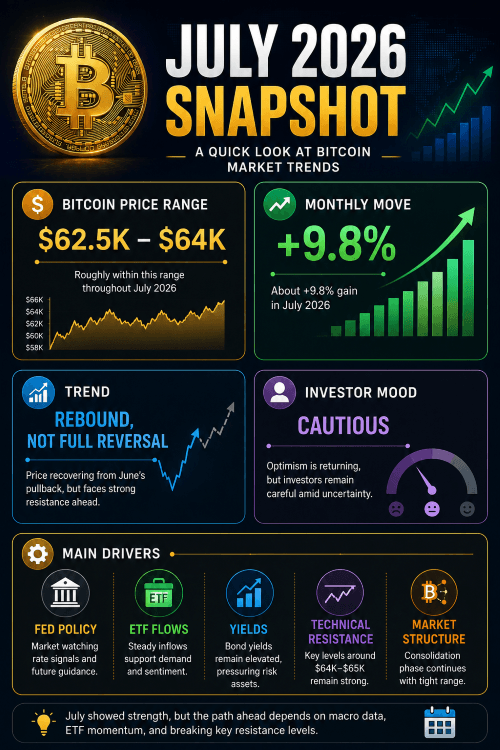
In simple terms, July 2026 gave Bitcoin some breathing room, but not complete strength. BTC traded around the low-to-mid $60,000 area during the month, with market reports placing it near $62,500 in mid-July and around $63,742 in later July commentary. It also rebounded about 9.8% during the month, which was encouraging after a weak stretch, but it still remained far below its 2025 all-time high of $126,198.07. That gap shows the market was stabilizing, not celebrating.
August 2026 begins with a clear question: was July’s bounce the start of a new leg higher, or just a relief rally inside a broader downtrend? The answer depends on a few big forces: Federal Reserve policy, U.S. spot Bitcoin ETF flows, Treasury yields, miner behavior, and whether Bitcoin can reclaim key resistance levels with real volume.
What Happened In July 2026?
July was a month of recovery, but not a clean breakout. Bitcoin spent much of the month consolidating around the $62,500 to $64,000 zone. IG UK noted that BTC was still well below its 2025 record high, while VanEck described the market as a consolidation phase rather than a strong recovery. That tells us the market had stopped falling aggressively, but had not yet shifted into a confirmed bullish trend.
The month’s 9.8% rebound was important because it showed that buyers were willing to defend lower levels. However, strong rebounds can happen in weak markets too. A real trend reversal usually needs follow-through: higher highs, stronger volume, and supportive macro conditions. July delivered some of that, but not enough to remove all doubt.
Why Bitcoin Moved In July
Three things mattered most in July.
First, the Federal Reserve stayed cautious. The Fed held rates at 3.5% to 3.75%, and the tone remained firm enough to limit risk appetite. Higher rates and elevated yields usually make Bitcoin less attractive in the short term because they increase the appeal of safer yield-bearing assets.
Second, ETF flows stayed important. By 2026, Bitcoin spot ETFs had become one of the clearest demand channels in the market. That means every inflow and outflow is now treated like a major sentiment signal. July showed mixed flow behavior, which meant institutional demand was present but not consistent enough to fuel a strong breakout.
Third, Bitcoin’s technical structure remained fragile. VanEck noted that Bitcoin was still trading below its 200-day moving average, while derivatives positioning and miner economics suggested caution rather than aggressive bullishness. In market terms, BTC looked compressed: it had room to move, but needed a catalyst.
Also Read Bitcoin Market Insights For June 2026 And Outlook For July 2026
Macro Backdrop: Why The Fed Still Matters
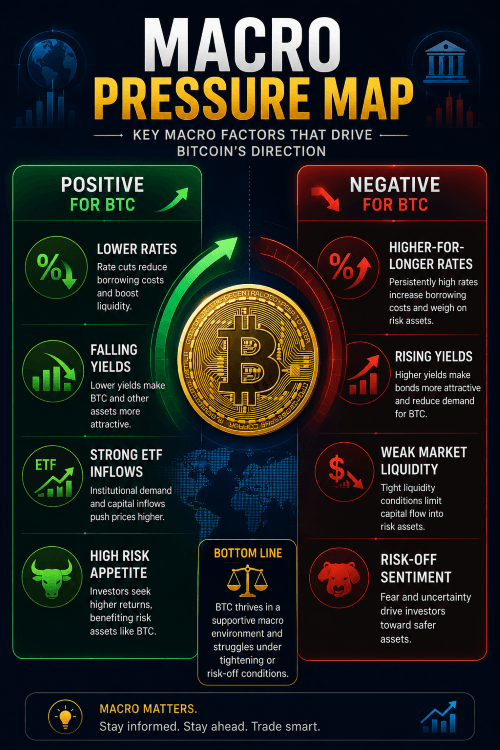
Bitcoin is no longer a purely crypto-native trade. In 2026, it behaves more like a macro asset. That means the Fed, Treasury yields, and the broader risk environment matter a lot more than they used to.
When rates stay high, risk assets usually face headwinds. Investors can earn more from cash or government bonds, so speculative assets like Bitcoin have to work harder to attract capital. July’s Fed stance was not a disaster for Bitcoin, but it was not a strong tailwind either. That helped keep BTC range-bound.
The takeaway is simple: when the macro backdrop is neutral to slightly restrictive, Bitcoin can recover, but it usually struggles to accelerate unless flows improve.
ETF Flows And Institutional Demand
One of the biggest structural changes in Bitcoin’s market is the rise of spot ETF demand. This has made institutional flows one of the most important signals for short-term direction.
July 2026 showed a mixed pattern. Some days saw strong inflows, while others brought outflows. That matters because Bitcoin now reacts quickly to changes in institutional demand. When flows are positive, BTC can defend support and build momentum. When flows weaken, price often struggles to hold gains.
This is also why Bitcoin can look strong one week and soft the next. ETF flows are not just background noise anymore. They are part of the market’s core plumbing.
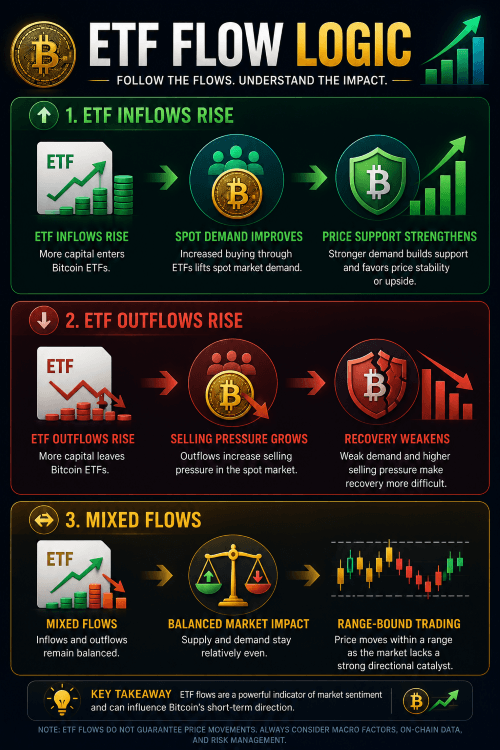
If you are watching Bitcoin in August 2026, ETF flow data is one of the most important things to track.
Technical Picture Going Into August
By the end of July, Bitcoin had not yet completed a full trend reversal. It had recovered enough to stabilize the chart, but not enough to reclaim major long-term levels.
The main support area going into August was around $60,000 to $63,000. If Bitcoin stays above this zone, the market can keep building a base. If it loses this area, a deeper retest becomes more likely.
The main resistance area is around $65,000 to $70,000. Bitcoin needs to reclaim this range with strong volume to prove the July bounce was more than just a temporary recovery. A move above this zone would improve sentiment and may open the door to a stronger August rally.
Also, Read Bitcoin Market Insights For May 2026 And Outlook For June 2026
Miner Pressure Remained Real
Bitcoin miners had a difficult month too. VanEck pointed out that miner economics were near multi-year lows and hash price was compressed. In plain language, miners were earning less per unit of work, which often creates stress across the mining sector.
When mining margins shrink, some miners may be forced to sell more BTC to cover costs. That can add supply pressure to the market. Smaller or less efficient miners are usually the first to feel the strain.
The good news is that miner pressure does not always lead to immediate price weakness. Sometimes it leads to long-term consolidation and healthier network efficiency. But in the short run, stressed miners can make it harder for Bitcoin to rally cleanly.
August 2026 Outlook: What To Expect
August is entering with a cautious setup. Several market commentators have pointed out that August has historically been one of Bitcoin’s weaker months. That does not guarantee a drop, but it does suggest the market starts the month without a strong seasonal advantage.
The key question for August is whether July’s rebound can turn into a genuine trend change. To do that, Bitcoin likely needs three things:
- Stable or positive ETF flows.
- Softer Treasury yields or more dovish Fed expectations.
- A clean break above the $65,000 to $70,000 resistance zone.
If those conditions happen, Bitcoin could build toward a more constructive August. If they do not, the market may stay trapped in consolidation or even retest lower support.
Bullish Scenario For August
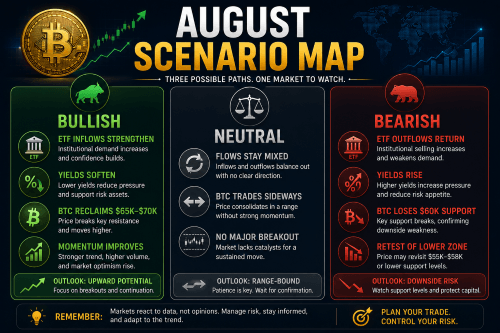
The bullish case is straightforward. If ETF inflows improve, the Fed becomes less restrictive in tone, and Bitcoin breaks resistance with volume, the market can extend the July bounce into a more durable recovery.
In that case, Bitcoin may first test the $65,000 area and then try to move toward $68,000 to $70,000. If it clears that zone, sentiment would likely improve quickly, and more buyers could step in. That would not guarantee a full bull market, but it would be a strong sign that July was the start of a larger base-building phase.
Bearish Scenario For August
The bearish case is also clear. If ETF demand weakens again, Treasury yields remain elevated, and Bitcoin fails to hold the $60,000 zone, the market could drift toward the $58,000 to $62,000 support range.
That would not necessarily destroy the long-term Bitcoin thesis, but it would delay recovery and keep traders cautious. It could also trigger more miner selling and make the market feel heavier.
In other words, Bitcoin does not need to collapse for August to be considered weak. It only needs to fail to confirm the July rebound.
What Investors Should Watch In August
Investors do not need to predict every move. They just need to monitor the right indicators.
Watch these closely:
- Spot Bitcoin ETF inflows and outflows.
- U.S. Treasury yields.
- Federal Reserve commentary.
- Bitcoin’s ability to hold the $60,000 to $63,000 area.
- Whether BTC reclaims $65,000 to $70,000.
- Trading volume during breakout attempts.
- Miner selling pressure and on-chain holder conviction.
These signals are more useful than price guesses alone. Bitcoin’s next move will probably depend more on liquidity and market participation than on headlines.
Also, Read Bitcoin Market Insights For April 2026 And Outlook For May 2026
Investment Approach For This Phase
For long-term investors, this looks like a disciplined accumulation environment rather than a chase-the-rally environment. That means using staggered entries, managing risk carefully, and avoiding emotional decisions based on short-term volatility.
For traders, patience is more important than prediction. A bounce is not the same as a breakout. It is better to wait for confirmation above resistance than to assume the market is already back in a strong uptrend.

Final Take
Bitcoin’s July 2026 performance was encouraging, but incomplete. The market recovered, but it did not fully reverse the broader downtrend. August 2026 begins with Bitcoin in a delicate position: stable enough to avoid panic, but not strong enough to assume a clean rally.
The next major move will likely depend on ETF flows, Fed policy, yields, and whether Bitcoin can reclaim resistance near $65,000 to $70,000. If those signals turn supportive, BTC can extend its recovery. If they do not, the market may remain stuck in a broad range or drift lower first.
For investors, the best approach is balanced. Respect the rebound, but do not overread it. Let the market confirm its direction before making aggressive assumptions.
FAQ
1. Was July 2026 bullish for Bitcoin?
July 2026 was mildly bullish in the sense that Bitcoin rebounded about 9.8%, but it was not a full bullish reversal. The market improved, yet it still traded far below its 2025 peak and remained technically fragile.
2. What was the main driver of Bitcoin in July 2026?
The main drivers were Federal Reserve policy, spot Bitcoin ETF flows, Treasury yields, and weak-to-mixed market liquidity. Miner pressure also mattered, but macro conditions were the bigger force.
3. Is August 2026 expected to be bullish for Bitcoin?
Not necessarily. August begins with a cautious setup, and many analysts see it as a confirmation month rather than a guaranteed breakout period. Bitcoin would likely need stronger ETF inflows and a break above key resistance to turn bullish.
4. What price levels matter most in August 2026?
The main support area is around $60,000 to $63,000. The main resistance area is around $65,000 to $70,000. A break above resistance would improve the outlook significantly.
5. Why are ETF flows so important now?
Spot Bitcoin ETFs are a major source of institutional demand. When flows are positive, Bitcoin gets support from real buying. When flows turn negative, price can weaken quickly.
6. Should investors buy Bitcoin in August 2026?
That depends on risk tolerance and time horizon. Long-term investors may prefer gradual accumulation, while traders should wait for confirmation. Bitcoin remains volatile, so position sizing and risk management are essential.