
Leverage has a strange effect on trading decisions. It makes a small market move capable of producing a large change in account equity, yet it often encourages traders to spend more time searching for entries than thinking about exposure.
That problem is not unique to crypto. Foreign-exchange traders have dealt with leveraged markets for decades, and many of the risk controls used in FX transfer surprisingly well to digital assets.
The instruments are different, of course. Crypto trades around the clock, liquidity can vary sharply between tokens and venues, and market-specific events can create sudden bursts of volatility. But the basic risk problem is the same: a trader has limited capital and an uncertain future price path.
The most useful lessons from FX are therefore not predictions. They are controls — rules that decide how much can be lost before a trade is entered.
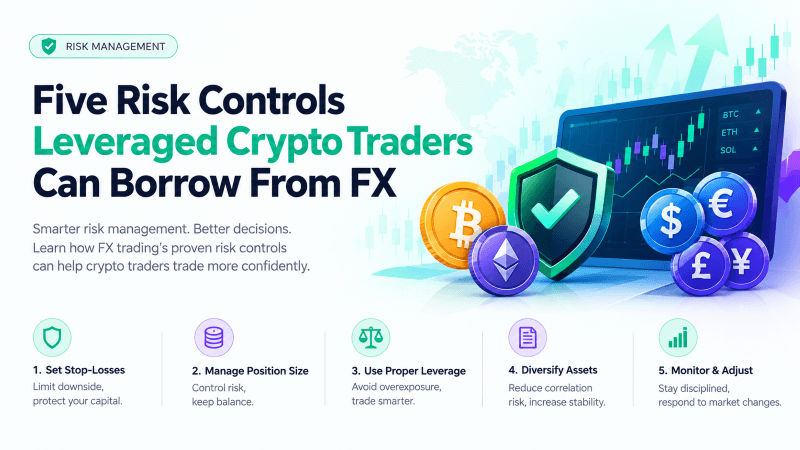
Here are five that leveraged crypto traders can adapt.
1. Decide the Account Risk Before Calculating the Position Size
A common mistake is choosing a position first and thinking about the potential loss afterward.
Risk-controlled trading reverses that order.
Start with the amount of account equity you are prepared to put at risk on the idea. Then identify the price level that would invalidate the trade. Only after those two numbers are known should position size be calculated.
The basic logic is simple:
Position size = acceptable monetary risk / loss per unit if the stop is reached
Suppose two traders have the same bullish Bitcoin view. One uses a tight stop and the other uses a wider stop because the second setup needs more room to remain technically valid. If both want to keep their account risk similar, they should not use the same position size. The wider stop normally requires a smaller position.
This is standard thinking in leveraged FX markets. For a practical example of translating stop distance into position size, the same concept is illustrated in Forex Wizard’s XAU/USD lot-size guide. The contract mechanics differ from crypto, but the risk principle is transferable: stop distance and position size should be considered together.
This also explains why copying somebody else’s trade size can be dangerous. Their account balance, entry price, stop distance, leverage and tolerance for loss may all be different.
There is no universal correct percentage to risk on a trade. The important point is that the maximum planned loss should be determined before the position is opened, not discovered after the market moves against it. This approach is central to crypto risk management.
Also, Read The Rise of AI-Powered Crypto Scams: How to Stay Safe
2. Treat Leverage as Financing, Not as Permission to Trade Bigger
Leverage changes how much capital is required to control a position. It does not improve the quality of the trade.
That distinction is easy to forget.
If a platform allows a trader to control $20,000 of exposure with a much smaller margin deposit, the market still moves against the full $20,000 position. A 2% adverse price move is calculated on the exposure, not on the amount that happened to be posted as margin.
This is why leverage and position size should be treated as separate decisions.
The first question should be: How large should the exposure be for this setup?
Only then should the trader consider how that exposure is margined.
The U.S. Commodity Futures Trading Commission has repeatedly warned that leverage amplifies both profits and losses in virtual-currency derivatives. A relatively small move in the underlying market can therefore have a disproportionately large effect on a leveraged account.
This matters even more when liquidation is involved. A normal unleveraged investor can often tolerate temporary price movement while deciding what to do. A highly leveraged position may not have that luxury. If available margin falls below the platform’s requirement, the position can be reduced or liquidated automatically.
A trader can be directionally correct over the longer period and still lose the position because the leverage did not allow the trade enough room to survive the path price took first.
The practical lesson borrowed from FX is straightforward: use leverage as a mechanism for capital efficiency, not as a target for maximum exposure.
3. Put the Stop Where the Trade Idea Is Wrong — Then Adjust the Size
Stops are often chosen backward.
A trader decides how much he or she wants to buy, calculates the largest loss that feels tolerable, and puts the stop wherever that amount happens to be reached.
That creates a stop based on the account rather than the market.
A more disciplined process starts with the chart.
If a long setup depends on a support zone holding, where would price need to trade before that idea is no longer valid? If a short setup depends on a failed breakout, what price action would prove that the breakout has actually succeeded?
That invalidation point provides the logical stop area. Position size can then be reduced or increased so the monetary risk fits the trader’s plan.
This becomes especially important when volatility expands. A stop that worked during a quiet period may sit inside normal market noise during a volatile session. Moving the stop farther away without reducing position size, however, increases account risk.
The solution is not simply to use wider stops. It is to connect three variables:
market structure, stop distance and position size.
There is another important limitation. A stop is a risk-management instruction, not a guaranteed exit price.
In fast markets, execution can occur away from the trigger price. Investor.gov notes this explicitly when explaining stop orders: once triggered, a stop can become a market order and the execution price may differ from the stop price, particularly when markets are moving quickly.
Crypto traders should therefore distinguish between the planned loss and the possible realized loss under poor execution conditions.
Also, Read How to Protect Your Crypto Wallet from Hackers in 2026: A Complete Security Guide
4. Price Liquidity and Slippage Into the Trade Before Entry
A chart can make every price level look equally tradable. The order book tells a different story.
Bitcoin on a major venue during an active period is not the same trading environment as a thin altcoin pair during quiet hours. A position that looks small on a chart can represent meaningful size relative to the liquidity actually available near the desired exit.
This matters on both sides of the trade.
At entry, slippage can produce a worse average price than expected. At exit, it can turn a planned loss into a larger one. During a rapid selloff, multiple stop orders may compete for the same available bids. During a sharp rally, short positions may be trying to cover at the same time.
The CFTC includes liquidity among the factors investors should examine when considering digital coins and tokens. That is not merely an investment concern; it is directly relevant to trade execution.
Before opening a leveraged crypto position, traders can ask a few simple questions:
- How liquid is this particular pair, not just the token generally?
- Is the position large relative to normal depth and volume?
- Does liquidity change materially at certain hours or on weekends?
- What happens to spreads during rapid moves?
- Is the stop order likely to become a market order once triggered?
The last point is especially important. A stop price should not be mentally treated as a guaranteed fill price.
FX traders learn quickly that spreads can widen and fills can deteriorate around volatile events. Crypto traders should build the same assumption into their risk planning.
If a strategy only works when every order is executed at the exact displayed price, the strategy has not fully accounted for real trading conditions.
Also, Read Bitcoin and Cryptocurrency Scams in 2025: $15 Billion Pig Butchering Fraud Exposed + Security Guide
5. Reduce Event Risk Instead of Pretending the Event Does Not Exist
Technical setups do not operate in a vacuum.
Crypto now reacts to many of the same macroeconomic events watched by FX traders: central-bank decisions, inflation data, employment reports, changes in interest-rate expectations and sudden shifts in the U.S. dollar or broader risk sentiment.
On top of those, digital assets have their own event risks — regulatory announcements, exchange problems, token listings or delistings, protocol upgrades, security incidents and other ecosystem-specific developments.
The important lesson from FX is not that traders must predict every announcement. It is that known event risk should be acknowledged before a position is opened.
Imagine a technically attractive setup appears shortly before a major scheduled economic release. There are at least three different decisions available:
- Take the trade at normal size and accept the event risk.
- Reduce the position because expected volatility is higher.
- Wait until after the release and reassess the structure.
What is dangerous is behaving as though the event does not exist and then treating the resulting volatility as an unpredictable accident.
High-impact events can create rapid price movement, temporary liquidity gaps and slippage. They can also invalidate technical levels that looked reliable minutes earlier.
This does not mean traders should automatically avoid every announcement. Different strategies have different objectives. It means event exposure should be intentional.
A useful pre-trade question is: If a known event produces a move much larger and faster than normal, does the position still fit my risk plan?
If the answer is no, the exposure may be too large.
Also, Read What Is DeFi? The Future of Decentralized Finance
A Simple Pre-Trade Risk Check
These five controls can be condensed into a short routine before placing a leveraged crypto trade:
What invalidates the setup?
Identify the price action that would show the original idea is wrong.
How much money can be lost?
Set the account risk before sizing the position.
What is the actual exposure?
Look at the full position value rather than focusing only on margin posted.
Can the market absorb the order?
Consider liquidity, spreads and likely slippage at both entry and exit.
What can change conditions suddenly?
Check scheduled macro events and relevant crypto-specific risks.
If any of those questions has no clear answer, the trader probably understands the entry better than the risk.
Risk Management Is Not About Avoiding Losses
No risk-control framework can prevent losing trades.
That is not its purpose.
A technically sound setup can fail. A strong market thesis can be wrong. A stop can suffer slippage. A surprise event can move price faster than expected.
Risk management exists so that one wrong idea does not decide the future of the account.
This may be the most valuable lesson leveraged crypto traders can borrow from experienced FX trading: the objective is not to make uncertainty disappear. It is to structure exposure so uncertainty can be survived.
Entries will always attract attention because they are visible on a chart. Risk controls are less exciting. They work quietly in the background through smaller position sizes, predefined invalidation levels, sensible leverage and awareness of liquidity and event risk.
Over enough trades, those decisions can matter more than finding a slightly better entry.
Sources and further reading
- U.S. Commodity Futures Trading Commission — Understand the Risks of Virtual Currency Trading
- U.S. Commodity Futures Trading Commission — Use Caution When Buying Digital Coins or Tokens
- Investor.gov — Stop Order
Disclaimer: This article is for educational purposes only and does not constitute financial or investment advice. Trading leveraged products involves substantial risk, including the possibility of losing capital.
Author Bio
Abdul Musawar is the founder of Forex Wizard, where he publishes educational content on XAU/USD, market structure, trading risk, and macro drivers affecting gold.
Website: Forex Wizard — XAU/USD Education & Market Analysis