
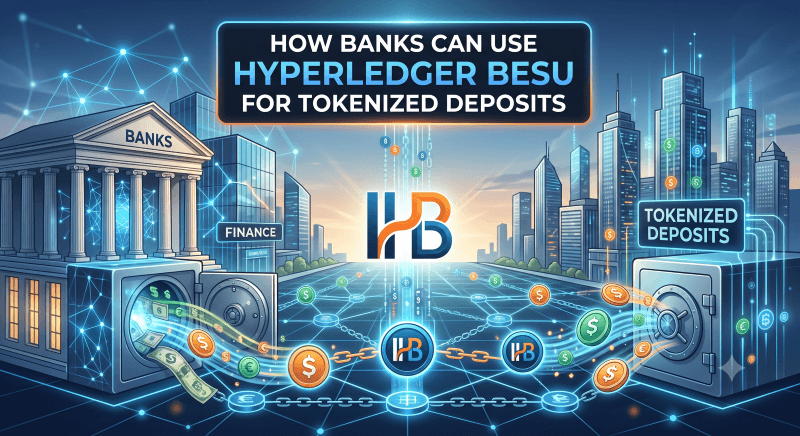
Banks’ tokenized deposits now power real payments and settlements. The goal is to combine programmable money with the controls expected of regulated bank infrastructure. That requires known participants, confidential transactions, predictable processing, and clear integration with existing systems.
Hyperledger Besu, now called Besu under LF Decentralized Trust, gives banks a strong foundation for this. The open-source Ethereum client can power a private, permissioned network with controlled participation and governance.
Build a controlled Besu network for bank money
A bank can use Besu to represent deposits as tokens on a shared ledger. The network may support internal liquidity movement or connect several institutions for interbank settlement, with access being restricted to approved participants.
Besu supports node-level and account-level permissioning. Node rules determine which machines may connect. Account rules determine which cryptographic accounts may submit or sign transactions. Banks can manage these controls locally or through on-chain smart contracts.
This structure helps a consortium formalize member admission, validator operation, and network changes. Business rules must still define the legal meaning of a tokenized deposit and when a transfer becomes final. Besu provides the technical coordination layer.
Add privacy beyond basic permissioning
Permissioning controls who may enter the network. Privacy controls what an approved participant may see. Banks need both.
Private transaction groups can allow two institutions to transact without exposing all transaction details to every other network member. This is important when deposit balances, counterparties, or payment terms are commercially sensitive.
Banks may add a modular privacy layer when the use case requires stronger confidentiality. The Besu stack is suitable for this. This kind of modular middleware can add controls across the application, network, asset, and ledger layers. Zero-knowledge proofs and selective disclosure can restrict sensitive information while preserving shared coordination.
Also, Read Seven Risk Labels Every Small-Liquidity Token Page Should Display
Program the deposit lifecycle
Besu follows the Ethereum specification, so banks can use Solidity smart contracts and established development tools. This allows a tokenized deposit to carry rules for transfer, escrow, and conditional release.
Consider a corporate payment linked to a trade transaction. A smart contract could hold the deposit token in escrow and release it when agreed conditions are met. The same approach can support treasury transfers or payment commitments that execute outside normal branch hours.
Ethereum compatibility also reduces dependence on a niche technology stack. Teams can use established tools and standard JSON-RPC interfaces. Smart contracts developed on a private Besu network can be adapted for other EVM environments with less rework.
Use deterministic finality for settlement certainty
Tokenized money needs a clear point of technical finality. Besu supports IBFT 2.0 and QBFT for networks with known validators. They finalize a block when it is committed and avoid uncertainty from chain forks.
That certainty matters when downstream accounting, liquidity, or settlement processes depend on the completed transfer. Private networks can also set gas prices to zero. Gas accounting can still limit computational work, while participants avoid fluctuating transaction fees. The result is a more predictable operating model, although actual performance will depend on network design, hardware, validator count, and smart contract complexity.
Connect the ledger to bank operations
A tokenized deposit network cannot operate as an isolated ledger. Banks need to connect it with core banking, identity, compliance, treasury, and payment systems. Integration can also extend to KYC and AML tools, RTGS infrastructure, ISO 20022 messaging, and external networks.
These connections allow a bank to keep customer records and regulatory controls aligned with on-ledger activity. They also help reduce reconciliation between separate systems because participants execute the same rules and arrive at the same ledger state.
Also, Read 5 Essential Risk Controls Crypto Traders Can Borrow From FX
Move from a focused use case to production
The strongest starting point is a use case with clear ownership and measurable value. A bank might begin with internal liquidity movement, corporate payments, or conditional escrow. A consortium can focus on interbank settlement. The governance, privacy, integration, and operating model can then be tested against that specific workflow.
Besu gives banks a credible route to tokenized deposits because it combines programmable settlement with institutional control. It can help create regulated money infrastructure that moves value with clearer rules, greater automation, and less operational friction.
Disclaimer: This article is for educational purposes only and does not constitute financial or investment advice. Trading leveraged products involves substantial risk, including the possibility of losing capital.