
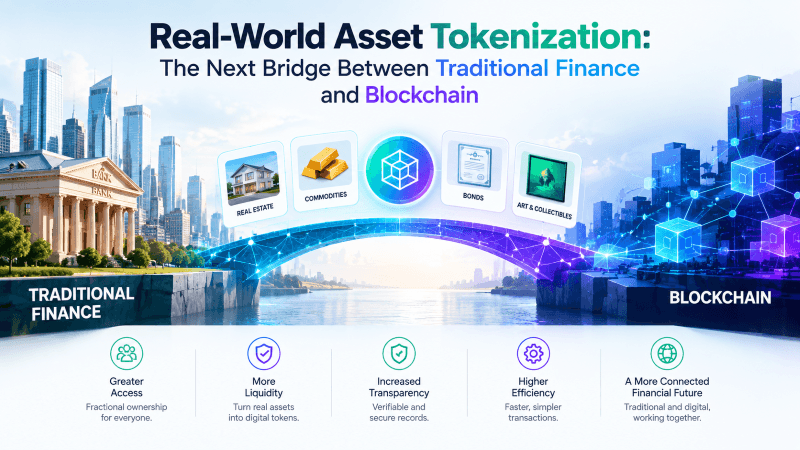
For years, blockchain has been associated mainly with cryptocurrencies, but some of its most consequential applications are now appearing around assets that already exist outside the crypto ecosystem. Government securities, money-market funds, real estate, private credit, and other financial instruments are increasingly being represented through blockchain-based tokens.
The interesting part is not that a traditional asset can be given a token. The harder question is what that token actually represents and how closely it remains connected to the asset, legal rights, custody arrangements, and settlement processes behind it. That distinction is becoming more important as financial institutions move from experiments toward production systems. In July 2026, DTCC announced that it had converted assets held at The Depository Trust Company into tokens that were subsequently used in real production trades, ahead of a planned October 2026 launch of its tokenization service.
The development points to a broader shift: real-world asset tokenization is increasingly being treated not simply as a crypto use case, but as an infrastructure layer connecting traditional finance with blockchain.
What Real-World Asset Tokenization Actually Means
Real-world asset tokenization refers to creating a blockchain-based representation of an asset or financial claim that exists in the traditional economy. That sounds straightforward, but the structure behind a token can vary considerably.
A token might represent a share in a regulated fund, a claim against an issuer, a beneficial interest in an asset, or another legally defined right. In other cases, the underlying asset remains under the control of a custodian while the blockchain records ownership or transfer of the corresponding interest.
A typical tokenization structure therefore includes several connected components:
- Underlying asset: A Treasury security, fund interest, bond, property interest, commodity or private-credit exposure.
- Legal structure: The documents and rules that define what the token holder is entitled to receive.
- Custody and verification: The mechanism used to hold or verify the underlying asset.
- Token issuance: The creation of the blockchain-based representation.
- Compliance controls: Rules governing who can hold, transfer or redeem the token.
- Settlement: The movement of the asset and payment between participants.
- Redemption: The process through which the token holder exits the structure or receives the underlying economic value.
This is why tokenization should not be confused with simply “putting an asset on a blockchain.” The blockchain is one part of a wider financial and legal system.
Also, Read How Banks Can Use Hyperledger Besu for Tokenized Deposits
The Token Is Only One Layer of the System
The strongest tokenization models connect blockchain infrastructure with systems that already exist in banking and capital markets. Consider a tokenized security. The blockchain can record transfers and execute predefined rules, but it does not independently establish whether the underlying security exists, whether an investor is legally entitled to hold it, or whether the issuer will honor the associated rights.
Those functions require other layers.
1. The underlying asset
The starting point can be a government security, investment fund, corporate bond, commodity or property interest.
2. The legal wrapper
A token needs a clearly defined relationship with the underlying asset. Without that relationship, ownership of a digital token does not necessarily mean ownership of the real-world asset.
3. Custody
The asset may remain with a regulated custodian, bank, fund administrator or another institution responsible for safekeeping and recordkeeping.
4. Token issuance
The blockchain representation is then created according to the relevant legal and technical structure.
5. Identity and compliance
Regulated products may require KYC, AML checks, investor eligibility rules and restrictions on transfers between wallets.
6. Settlement
Payment and asset delivery can potentially be synchronized, reducing some of the reconciliation involved in separate systems.
7. Redemption
The holder needs a defined route back to the underlying economic value.
This layered model is important because it explains why RWA tokenization is not simply a competition between traditional finance and crypto. It is increasingly about connecting the two.
Which Real-World Assets Are Reaching the Blockchain First?
Not every asset has the same tokenization profile.
Assets with established ownership structures, standardized documentation and existing digital records can be easier to connect to blockchain infrastructure than assets where ownership is fragmented or difficult to verify.
| Asset class | Why tokenization is attractive | Main friction |
| Government securities | Standardized instruments with established settlement and collateral use | Securities regulation and market infrastructure |
| Money-market funds | Defined ownership and valuation structures | Fund administration and transfer rules |
| Corporate and private bonds | Potentially simpler issuance and settlement workflows | Legal structures and market liquidity |
| Private credit | More programmable servicing and recordkeeping | Valuation and limited secondary markets |
| Real estate | Potential for fractional interests and digital transfer | Property law, title systems and valuation |
| Commodities | Digital claims can accompany verified physical holdings | Custody and physical verification |
Government securities and regulated investment products are particularly important because institutions already have established processes for custody, valuation, and investor eligibility. Real estate illustrates the other side of the equation. The asset can be represented digitally, but the token still needs to connect with property records, legal ownership and the rules governing transfers.
Also, Read 5 Essential Risk Controls Crypto Traders Can Borrow From FX
Why Financial Institutions Are Moving Beyond Experiments
The shift in 2026 is becoming visible through actual market infrastructure rather than only pilot announcements. DTCC’s July 2026 production activity is a notable example. The organization said tokenized assets held through DTC were used in production trades across multiple use cases, marking a step toward integrating tokenized assets with established post-trade infrastructure. Its planned tokenization service is expected to launch in October 2026.
The significance is broader than the technology itself.
The industry is now testing whether tokenized securities can operate alongside the systems that already handle custody, settlement, ownership rights, and investor protections. DTCC has said its tokenization service is designed around DTC-custodied assets and to preserve the same entitlements, investor protections, and ownership rights associated with assets held in traditional form.
That makes the model fundamentally different from creating an independent crypto asset and assigning it a reference to a traditional instrument.
Tokenization Is Also Moving Into Existing Investment Products
One of the clearest examples is Franklin Templeton’s Franklin OnChain U.S. Government Money Fund, represented by the BENJI token.
The fund launched in 2021 and uses a public blockchain as its official system of record for processing transactions and recording share ownership. Franklin Templeton reported that BENJI represented more than $650 million on the Stellar network in April 2026, while the broader BENJI suite represented approximately $1.98 billion in assets under management as of April 29, 2026.
The significance lies in the product structure.
This is not a cryptocurrency created to imitate a money-market fund. It is a regulated investment product using blockchain infrastructure for ownership records and transfers. Franklin Templeton also reports peer-to-peer transfer functionality, intraday yield distribution, and 24/7 on-chain activity. The example demonstrates where tokenization can become more useful: not by replacing established financial products, but by changing how parts of those products are issued, transferred, and recorded.
Real Estate Shows Both the Promise and the Complexity
Property is often presented as one of the most compelling RWA opportunities because real estate is large, relatively illiquid, and traditionally expensive to transact. Yet it also exposes the limitations of tokenization.
Dubai Land Department provides a useful example. In 2025, the authority launched the first phase of its real-estate tokenization initiative, including a tokenized property ownership certificate. The first project attracted 224 investors from 44 nationalities, with an average individual investment of AED 10,714. The initiative involved the Dubai Land Department, the Virtual Assets Regulatory Authority, the Central Bank of the UAE, and other partners through the Real Estate Sandbox.
The important point is not simply that property was tokenized.
The project required the blockchain representation to remain connected to an official property ownership framework. That is the central challenge with many physical RWAs: a blockchain can record a transaction, but the asset still exists within a legal and physical environment outside the chain.
Also, Read How to Protect Your Crypto Wallet from Hackers in 2026: A Complete Security Guide
The Bridge Needs Digital Money Too
Tokenized assets are only part of the settlement equation. If a tokenized bond or security changes hands, the payment leg also needs to move efficiently. That creates a second question: what form should the settlement money take?
J.P. Morgan’s Project Acacia trial in Australia offers one example. The 2026 trial brought together a Commonwealth Bank deposit token, wholesale Australian-dollar central bank digital currency, and tokenized securities in a repo-market transaction. The project was designed to test how digital money and tokenized assets could interact within Australia’s wholesale funding markets.
A future tokenized financial system may involve: Tokenized asset + tokenized money + regulated settlement infrastructure
Rather than simply: Asset + blockchain
Once both legs can interact through programmable infrastructure, automated settlement, collateral movement, and conditional transactions become more practical.
Regulation Decides What the Token Actually Represents
Regulation remains one of the most important parts of RWA tokenization because the same blockchain architecture can support very different products depending on what rights the token provides.
In the United States, the Securities and Exchange Commission issued temporary conditional exemptive relief on September 17, 2026, allowing certain Tokenized Securities Venues to trade tokenized NMS stocks under defined conditions. The order includes requirements intended to ensure that tokenized stocks provide holders with the same rights and privileges as the equivalent traditional securities.
The European approach has also evolved through a combination of existing securities rules and the DLT Pilot Regime. The European Commission states that MiCA does not cover tokenized deposits or securities, which remain subject to existing banking and securities legislation. The DLT Pilot Regime instead allows market participants to test trading and settlement of certain tokenized financial instruments, including shares, bonds and UCITS.
The broader lesson is straightforward: The key question is not whether an asset is on a blockchain. It is what legal and economic rights the token gives its holder.
The Broader Digital-Asset Infrastructure Is Moving Toward Tokenization
The infrastructure supporting tokenized assets is also becoming more closely integrated with conventional financial services. Markntel Advisor estimates the global cryptocurrency market at USD 9.29 billion in 2026, up from USD 7.89 billion in 2025, with the market projected to reach USD 22.39 billion by 2032 at a 15.8% CAGR. More importantly for the tokenization discussion, its latest research identifies the convergence of traditional finance and decentralized finance through tokenization as a key structural trend shaping the digital-asset ecosystem.
The same research points to growing institutional use of blockchain for settlement, custody, payments, and tokenized financial services. Blockchain platforms accounted for approximately 48% of the cryptocurrency market in 2026, reflecting their role as the underlying infrastructure for asset issuance, smart-contract execution, and other blockchain-based financial applications.
For RWA tokenization, that infrastructure layer matters as much as the token itself. The ability to issue a digital representation is only useful when it can connect with custody, identity, compliance, settlement, and other financial systems already used by institutions.
Tokenization Does Not Automatically Create Liquidity
One of the easiest assumptions to make about RWAs is that placing an asset on a blockchain automatically makes it liquid. A token can be technically transferable without having an active secondary market. A tokenized property interest can still have a limited pool of buyers. A private-credit token can remain difficult to value. A regulated security can still be restricted to eligible investors.
This creates an important distinction between transferability and liquidity.
Blockchain can reduce friction around how an asset is transferred or recorded. It cannot create buyers where none exist. The size of the opportunity, therefore, will depend not only on how quickly assets are tokenized, but also on whether functioning markets develop around them.
What Still Has to Be Solved
Several practical questions remain before tokenization can move from individual products to broader market infrastructure.
- Who verifies the underlying asset? For financial securities, regulated custodians and established records can provide that connection. Physical assets can be more difficult because the blockchain cannot independently confirm that a commodity, property, or collectible exists as represented.
- Who recognizes the token legally? A blockchain transaction can show that a token moved from one wallet to another. The legal system still determines what rights accompanied that movement.
- How does identity work? Many tokenized products cannot operate like unrestricted cryptocurrencies. Investor eligibility, jurisdiction, KYC, and AML requirements may need to travel with the asset.
- Can different systems communicate? Institutional tokenization will not necessarily happen on one blockchain. Banks, custodians, trading venues, and settlement networks need ways to exchange information and value across different systems.
- What happens when something goes wrong? Lost credentials, incorrect transfers, insolvency, corporate actions, disputes, and redemption failures all require governance beyond the smart contract itself.
These are infrastructure questions rather than simply blockchain questions.
What the Traditional Finance–Blockchain Bridge Looks Like
In a traditional structure, an investor interacts with fund infrastructure, transfer records, custodians, and settlement systems. Multiple databases and intermediaries can be involved in updating ownership and reconciling transactions.
A tokenized structure can change the sequence.
- Investor
- Compliant wallet
- Token transfer
- Blockchain record
- Fund and custody
- Infrastructure
- Settlement or redemption
The blockchain can make the transfer record programmable and easier for participating systems to share. But several elements remain.
The fund still has an underlying portfolio. The investor still has defined legal rights. Custody still matters. Valuation still matters. Regulatory obligations still apply. That is why the most realistic vision for RWA tokenization is not the disappearance of traditional finance. It is the redesign of how traditional financial assets move through financial infrastructure.
The Next Stage of RWA Tokenization
The next phase may therefore be less about tokenizing as many asset classes as possible and more about connecting tokenized assets to the rest of the financial system. That means developing:
- regulated secondary markets;
- institutional custody;
- interoperable blockchain infrastructure;
- compliant identity and wallet systems;
- tokenized settlement money;
- standardized legal structures; and
- reliable redemption mechanisms.
Recent developments from DTCC, regulated fund platforms, central banks, financial institutions, and securities regulators point in the same direction: blockchain is increasingly being tested as infrastructure for financial assets rather than only as a venue for crypto-native assets. The bridge between traditional finance and blockchain, however, will not be built by the token alone.
It will depend on whether the token, legal claim, underlying asset, custody arrangement, settlement mechanism, and regulatory framework can operate together as one functioning system.
Author Bio
Shammi Thakur is the Research Director at Markntel Advisor, with more than 15 years of experience in strategic market intelligence, industry forecasting, and competitive analytics. He leads global research mandates across diverse industries, overseeing the development of comprehensive market studies and advisory frameworks.
Disclaimer: This article is for educational purposes only and does not constitute financial or investment advice. Trading leveraged products involves substantial risk, including the possibility of losing capital.