
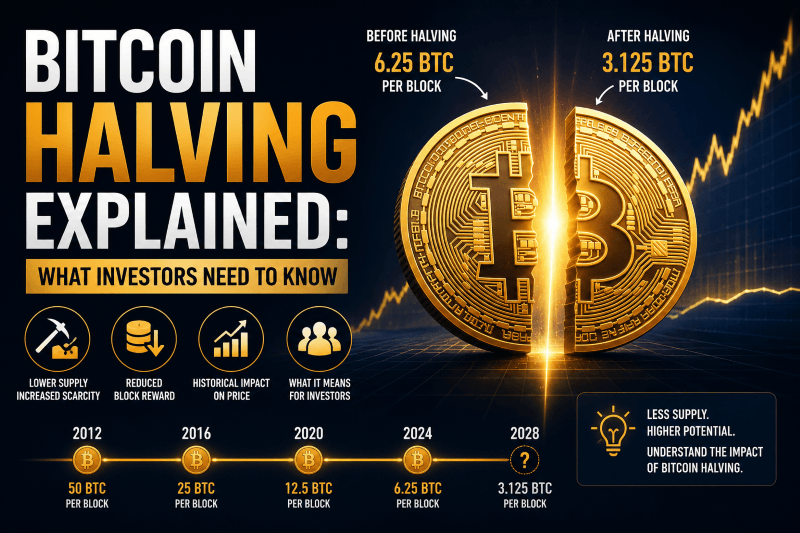
Bitcoin halving is a built-in event that cuts the reward for mining new Bitcoin blocks in half roughly every four years, reducing the rate at which new BTC enters circulation and reinforcing Bitcoin’s fixed supply model of 21 million coins. For investors, the key takeaway is simple: halvings do not guarantee price gains, but they do change supply dynamics, miner economics, and market expectations in ways that often matter a lot.
Bitcoin Halving Explained: What Investors Need to Know
Bitcoin halving is one of the most important events in the crypto market, yet it is also one of the easiest to misunderstand. Many people hear “halving” and assume it automatically means prices will rise, but the real story is more nuanced. The event changes Bitcoin’s issuance rate, affects miner profitability, and often reshapes investor sentiment months before and after the event.
This report breaks the topic into plain language so investors can understand what halving actually does, why markets pay attention to it, and how to think about risk and opportunity during halving cycles.
What Is Bitcoin Halving?
Bitcoin halving is a programmed reduction in block rewards. When miners successfully add a block to the Bitcoin blockchain, they receive newly created BTC as compensation; the halving cuts that reward by 50% every 210,000 blocks, which works out to about once every four years.
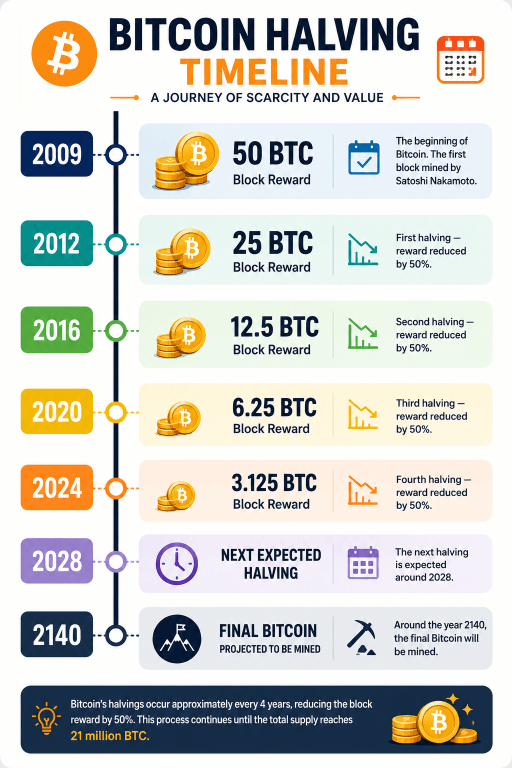
At launch, the reward was 50 BTC per block. It fell to 25 BTC in 2012, 12.5 BTC in 2016, 6.25 BTC in 2020, and 3.125 BTC after the April 2024 halving. The mechanism is hard-coded into Bitcoin’s protocol and is designed to keep issuance predictable until the final coin is mined around 2140.
Also, read The Complete Beginner’s Guide to Cryptocurrency Investing in 2026
From an investor’s perspective, the halving matters because it reduces the pace of new supply entering the market. That makes Bitcoin unlike fiat currencies, where supply can be expanded more freely by central banks; Bitcoin’s issuance schedule is transparent, fixed, and known in advance.
Historical Impact on Bitcoin Prices
Historical halvings have often been followed by strong price cycles, but the timing and size of those moves have varied a lot. Fidelity notes that Bitcoin has historically made new highs after halvings, while CNBC reported that after the 2012, 2016, and 2020 halvings, Bitcoin eventually surged by roughly 93x, 30x, and 8x from the halving-day price to each cycle’s peak.
A useful way to read history is not as a promise, but as a pattern of market behavior. The 2012 halving occurred when Bitcoin was around $12, and it climbed to about $266 by April 2013 according to Fidelity’s summary. The 2020 halving happened around $8,700, and Bitcoin later reached about $69,000 in that cycle. These moves suggest that halving can act as a narrative catalyst, especially when broader demand is also rising.
But history also warns against oversimplification. Yahoo Finance highlighted that there is no concrete proof that halvings directly cause price increases, and that other forces such as liquidity, macro conditions, speculative demand, and miner selling can also shape outcomes. In other words, the halving may tighten supply, but price still depends on whether buyers show up afterward.
Supply and Demand Economics
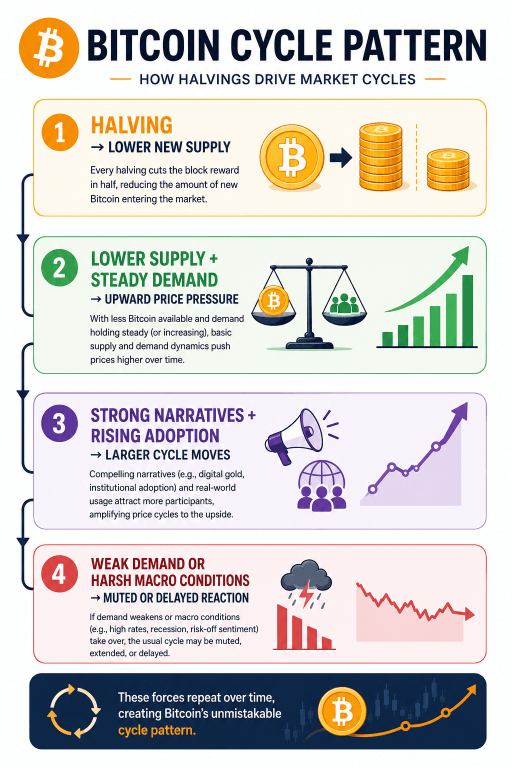
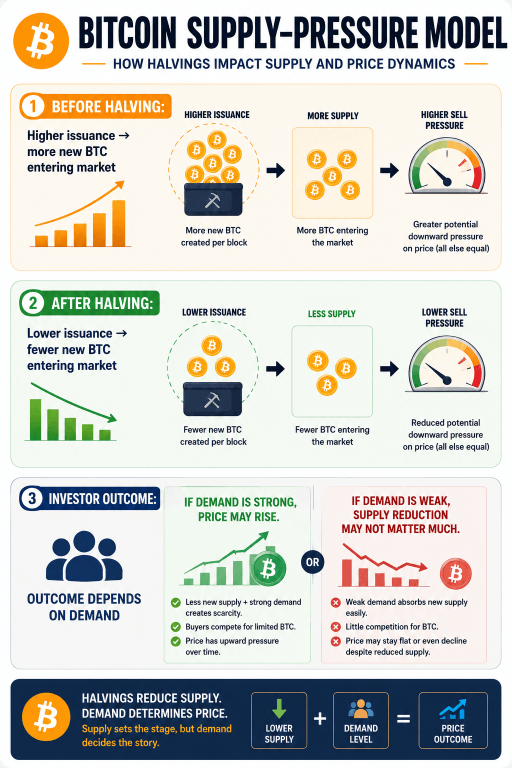
The core economic logic behind Bitcoin halving is scarcity. When the supply of newly issued Bitcoin falls, the market must absorb fewer fresh coins each day; if demand stays the same or rises, price pressure can tilt upward. This is why halving is often compared to a supply shock rather than a demand event.
Bitcoin’s supply schedule is especially powerful because it is predictable. Traders know when the next reduction is likely to happen, so markets often price in expectations ahead of time rather than waiting for the exact block to land. That means the strongest price reaction may appear before the event, during the months when scarcity narratives and speculative positioning intensify.
Also, read The Rise of AI-Powered Crypto Scams: How to Stay Safe
For investors, the important lesson is that halving alone does not create demand. It creates a tighter supply environment, but the price outcome depends on whether Bitcoin is also benefiting from adoption, institutional interest, liquidity expansion, or a favorable risk-on market.
How Miners Are Affected
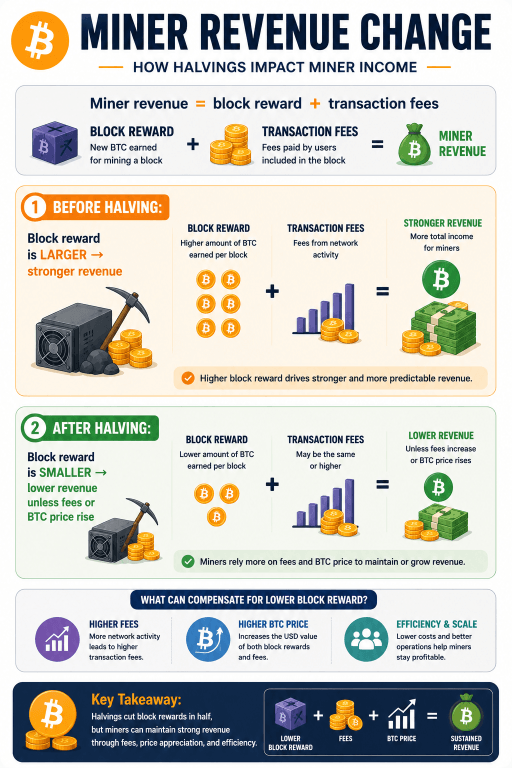
Miners feel the halving immediately because their block reward is cut in half. That means their revenue from new coin issuance drops overnight, while many of their costs, such as electricity, equipment, cooling, and maintenance, remain the same. Fidelity notes that miners generally do not look forward to halvings for exactly this reason.
This squeeze tends to separate efficient miners from weaker ones. Large operations with low-cost power, modern hardware, and strong treasury management are better positioned to survive the reduced reward environment, while higher-cost miners may be forced to shut down or sell Bitcoin reserves. Over time, that can lead to consolidation in the mining industry.
Transaction fees become more important after each halving because they are the remaining reward once issuance falls further. Bitcoin’s long-term security model assumes that fees will eventually provide enough incentive for miners, especially after the last Bitcoin is mined around 2140. The open question is whether fee revenue will be consistently strong enough to support miner participation at scale.
Market Predictions After Halving Events
Market predictions around halving are usually split into three camps. The first camp expects higher prices because supply growth slows and historical cycles have often been bullish. The second camp says the event is already priced in, since everyone knows the schedule well in advance. The third camp focuses on miner selling and macro conditions, arguing that these can overwhelm any halving effect in the short term.finance.
Analysts quoted by CNBC around the 2024 halving pointed in different directions: some expected post-halving weakness, while others believed prices could remain high over the longer term. That split is a reminder that halving is not a standalone forecast tool; it is one variable in a much larger market system.
For practical investing, the most realistic view is that halving may increase the probability of a bullish cycle, but it does not guarantee one. Strong outcomes are usually associated with a combination of reduced issuance, rising demand, and supportive market liquidity. Weak outcomes are more likely when macro conditions are tight, risk appetite is low, or miners need to sell more aggressively.
Investment Strategies During Halving Cycles
A sensible halving-cycle strategy starts with risk control, not prediction. Since Bitcoin is volatile and speculative, Fidelity stresses that investors should only allocate capital they can afford to lose. That is especially important during halving cycles, when excitement can create poor entry decisions.
One common approach is staggered buying, often called dollar-cost averaging. Instead of trying to guess the perfect halving date or peak, investors buy fixed amounts over time and reduce the risk of entering at a short-term top. This approach is often better suited to long-term believers than all-in directional bets.finance.
Another useful strategy is to separate thesis from timing. If your thesis is that Bitcoin’s fixed supply makes it a long-term scarcity asset, then the halving matters because it reinforces that thesis. But if your goal is short-term trading, you need to account for volatility, sentiment shifts, and the possibility that the market has already priced in the event. A disciplined plan should define entry levels, profit-taking rules, and maximum downside before any purchase.
Practical investor checklist
- Use position sizing that matches your risk tolerance.
- Consider phased entries instead of lump-sum buying.
- Watch miner behavior, exchange flows, and macro liquidity.
- Avoid assuming every halving will repeat the last cycle.
- Treat narrative-driven rallies as opportunity, not certainty.
What Investors Should Remember
Bitcoin halving is best understood as a supply-reduction event with long-term monetary significance, not a guaranteed price trigger. It matters because it changes Bitcoin’s issuance schedule, affects miner economics, and often influences how investors think about scarcity.finance.
The historical pattern is real enough to deserve attention, but it should not be turned into a simplistic rule. Prices have often risen after halvings, yet those gains happened in broader market environments that were also favorable. The smartest investors use halving as one part of a larger framework that includes valuation, liquidity, sentiment, and risk management.
Bitcoin halving is therefore less of a magic event and more of a structural milestone. It keeps Bitcoin’s monetary policy predictable, reinforces scarcity, and creates recurring cycles that investors study closely. For anyone evaluating Bitcoin as an asset, understanding halving is essential to understanding the asset itself.
Also, read How to Protect Your Crypto Wallet from Hackers in 2026: A Complete Security Guide