
Solana processes 65,000 transactions per second. For context, Visa handles about 24,000. Ethereum? Roughly 15–30 on its base layer.
That speed — combined with fees that barely register (we’re talking fractions of a cent) — is why Solana went from “interesting experiment” to top-3 cryptocurrency in just a few years. But speed isn’t the whole story.
If you’ve been following our beginner’s guide to Bitcoin, you know the basics of blockchain. Solana takes those same principles and rebuilds the engine from scratch. Here’s what you actually need to know.
What is Solana? The Simple Explanation
Think of Solana as Ethereum’s faster, cheaper cousin. Both are smart contract platforms — meaning developers can build apps on top of them (DeFi protocols, NFT marketplaces, games, payment systems). But where Ethereum prioritizes decentralization above all else, Solana made a different bet: throughput first.
Founded in 2017 by Anatoly Yakovenko (a former Qualcomm engineer), Solana launched its mainnet in March 2020. The goal was straightforward: build a blockchain that doesn’t force users to choose between speed, cost, and security.
Spoiler: they mostly pulled it off.
How Does Solana Work? (Without the Computer Science Degree)
Two innovations make Solana different. Understanding them helps you see why it’s fast — and where the trade-offs live.
Proof of History: The “Clock” That Changed Everything
Most blockchains rely on validators agreeing on when a transaction happened. That consensus process takes time. Solana’s breakthrough was Proof of History (PoH) — a cryptographic clock that timestamps transactions before they reach consensus.
Imagine a relay race where every runner carries a stopwatch that can’t be tampered with. When they pass the baton, the next runner knows exactly when the previous one finished — no arguing required. That’s PoH in a nutshell.
The result? Validators spend less time coordinating and more time processing. Transactions get ordered instantly.
Proof of Stake: Securing the Network
PoH handles ordering. Proof of Stake (PoS) handles security. Validators stake SOL tokens as collateral. Act honestly → earn rewards. Act maliciously → lose your stake. Standard stuff, but combined with PoH, it creates a system where blocks finalize in ~400 milliseconds.
Why It’s Actually Fast: Parallel Processing
Here’s the part most explanations miss. Ethereum processes transactions sequentially — one after another, like a single checkout line. Solana uses Sealevel, a runtime that identifies independent transactions and runs them simultaneously across multiple CPU cores.
Sending USDC to a friend? That’s independent of someone minting an NFT. Both happen at the same time.
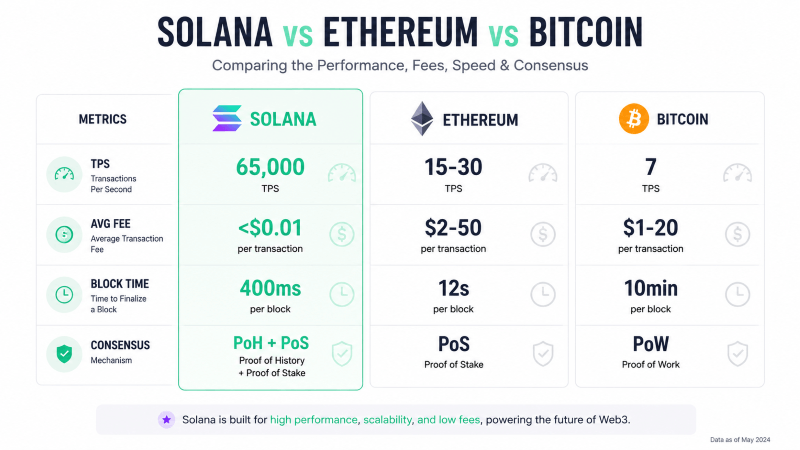
Quick Comparison: Solana vs Ethereum vs Bitcoin
| Metric | Solana | Ethereum (L1) | Bitcoin |
|---|---|---|---|
| TPS (theoretical) | 65,000+ | ~15–30 | ~7 |
| Avg. Fee | <$0.01 | $2–$50+ | $1–$20 |
| Block Time | ~400ms | ~12s | ~10min |
| Consensus | PoH + PoS | PoS | PoW |
| Smart Contracts | Yes (Rust) | Yes (Solidity) | Limited |
SOL Token — What You Actually Need to Know
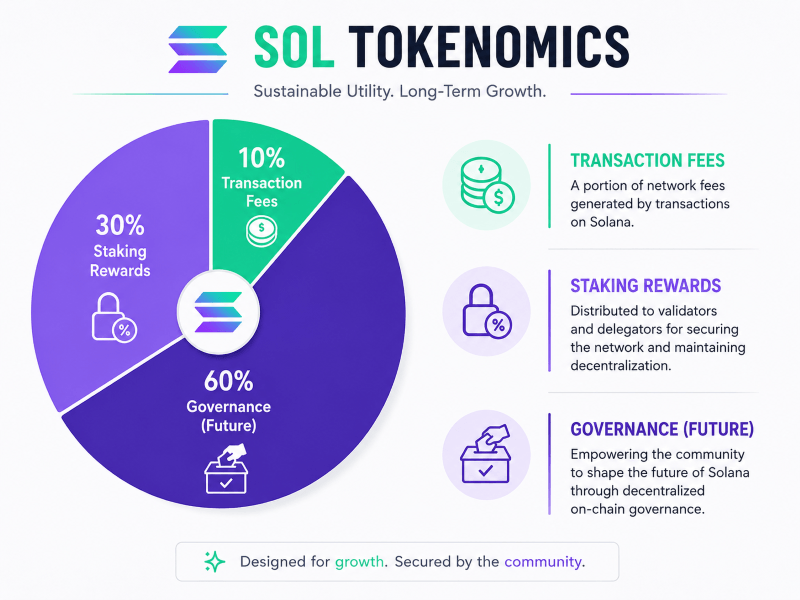
SOL isn’t just “the coin you buy.” It does three jobs:
1. Transaction Fees
Every action on Solana — sending tokens, minting NFTs, swapping on Jupiter — costs a tiny amount of SOL. Most transactions cost 0.000005 SOL (about $0.0001 at current prices).
2. Staking & Network Security
You can delegate SOL to validators and earn ~6–8% APY. More on this below.
3. Governance (Eventually)
SOL holders will vote on protocol upgrades. The mechanism is still evolving, but the direction is clear: token holders steer the ship.
Tokenomics at a Glance
- Total Supply: No hard cap (currently ~570M circulating)
- Inflation: Starts ~8% annually, decreases ~15% per year until ~1.5% terminal
- Burn Mechanism: 50% of transaction fees are burned, creating deflationary pressure as usage grows
Where to Buy SOL
Same places you’d buy any major crypto: Binance, Coinbase, Kraken, Bybit, OKX. If you’ve followed our guide to buying Ethereum, the process is identical — just search “SOL” instead of “ETH.”
What’s Actually Built on Solana in 2026?
A blockchain is only as good as what runs on it. Here’s where the action is:
DeFi (Decentralized Finance)
- Jupiter — The go-to swap aggregator (think 1inch for Solana)
- Raydium — AMM + order book hybrid, deep liquidity
- Marinade & Jito — Liquid staking (stake SOL, get mSOL/JitoSOL, use in DeFi while earning staking rewards)
NFTs
- Magic Eden — Dominant marketplace, expanded to Bitcoin ordinals and Ethereum
- Tensor — Pro trader favorite, real-time floor sweeps, advanced tooling
Gaming
- Star Atlas — Ambitious space MMO, still building but technically impressive
- Aurory — JRPG-style with play-and-earn mechanics
Payments & Real-World Assets
- Solana Pay — Merchant payment framework, used by Shopify stores
- Helium — Decentralized wireless network (migrated from its own chain)
- Parcl / Homebase — Tokenized real estate exposure
The ecosystem has matured past the “speculation only” phase. Real users. Real volume. Real revenue.
Solana vs Ethereum — The Honest Comparison
This is the question everyone asks. Here’s the breakdown without the tribalism.
Speed & Fees: Solana Wins (Handily)
Sub-second finality. Fees you literally cannot feel. For high-frequency use cases — trading, gaming, micropayments — there’s no contest.
Decentralization: Ethereum Wins
Ethereum has ~1M+ validators. Solana has ~2,000–3,000 active validators, and the hardware requirements to run one are steep (high-end server, not a laptop). This centralization concern is real, though the validator set has grown significantly since 2022.
Ecosystem Maturity: Ethereum Leads, Solana Catching Up
Ethereum has 8+ years of battle-testing, the largest developer community, and the most TVL. Solana’s TVL has recovered strongly post-FTX, but Ethereum’s moat is deep.
Developer Experience: Different, Not Better/Worse
- Ethereum: Solidity, massive tooling, huge talent pool
- Solana: Rust/C, steeper learning curve, but Anchor framework makes it manageable. Developers who learn both tend to prefer Rust’s safety guarantees.
The Verdict?
They’re solving for different priorities. Ethereum = settlement layer, maximum trust minimization. Solana = execution layer, maximum throughput. Both will coexist. The “Ethereum killer” narrative was always lazy.
Is Solana a Good Investment in 2026?
Standard disclaimer: This isn’t financial advice. DYOR. Crypto is volatile.
The Bull Case
- Adoption metrics trending up: Active addresses, DEX volume, stablecoin supply (USDC on Solana > $5B)
- Institutional interest: Franklin Templeton, PayPal (PYUSD), Stripe (Solana Pay integration)
- Mobile push: Saga phone (v2 coming), Seeker device — crypto-native hardware distribution
- Developer retention: Solana Foundation reports growing full-time dev count
- ETF filings: VanEck, 21Shares filed for spot SOL ETFs (decision pending)
The Bear Case
- Network outages: 5+ major halts since 2021 (though none since Feb 2024 — Firedancer client upgrade helps)
- Centralization risk: Validator hardware costs, token distribution (VCs/insiders held large early allocations)
- Regulatory uncertainty: SEC has labeled SOL a security in some enforcement actions
- Competition: Ethereum L2s (Arbitrum, Optimism, Base), plus new L1s like Aptos, Sui, Monad
Price Predictions (Take With Salt)
| Source | 2026 Target | Methodology |
|---|---|---|
| VanEck | $330–$1,000 | Revenue multiple on fee capture |
| CoinCodex | $180–$280 | Technical + on-chain metrics |
| Messari | $200+ | Fundamental adoption curves |
Our take: Solana’s fundamentals are stronger than the price reflects. But crypto markets price narratives, not fundamentals — at least in the short term.
If you’re new to crypto investing entirely, start with our complete beginner’s guide to cryptocurrency investing before allocating to any single asset.
How to Stake SOL & Earn Passive Income
Staking is the closest thing to a “risk-free” return in crypto (though no crypto is truly risk-free).
Option 1: Native Staking (6–8% APY)
Delegate directly to a validator via Phantom, Solflare, or Ledger Live. You choose the validator. Your SOL stays in your wallet. Unstaking takes ~2–3 days (cooldown epoch).
Pro tip: Avoid the top 5 validators by stake. Spread delegation to support decentralization. Check validators.app for commission rates and performance.
Option 2: Liquid Staking (7–10% APY)
Deposit SOL → receive mSOL (Marinade) or JitoSOL (Jito) → use those tokens in DeFi while earning staking yield.
- Marinade: Native liquid staking, auto-delegates across 100+ validators
- Jito: MEV-boosted yields (validators capture maximal extractable value, share with stakers)
Liquid staking tokens trade at a slight premium to SOL and compound automatically. Our crypto staking guide goes deeper on the mechanics.
Best Solana Wallets for Beginners
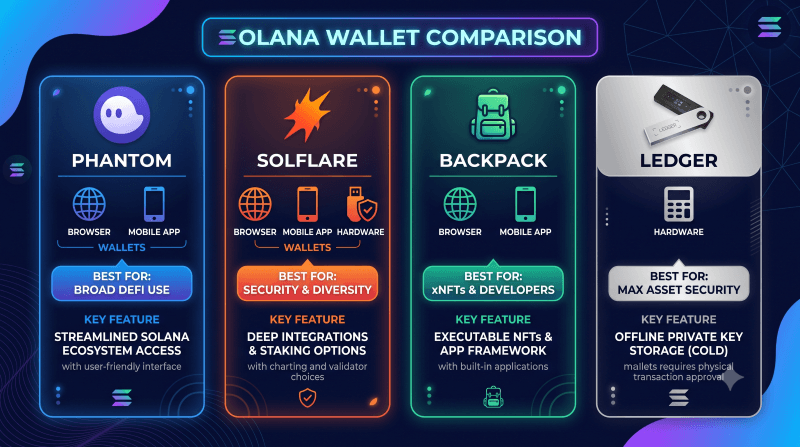
| Wallet | Type | Best For | Notable Feature |
|---|---|---|---|
| Phantom | Hot (browser/app) | Most beginners | Clean UI, built-in swap, NFT gallery |
| Solflare | Hot (browser/app/hardware) | Power users | Detailed staking dashboard, Ledger support |
| Backpack | Hot (browser/app) | xNFT collectors | Native xNFT (executable NFT) support |
| Ledger + Solana App | Cold (hardware) | Large holdings | Maximum security, works with Phantom/Solflare |
Our rule: Hot wallet for daily use (<$1K). Hardware wallet for everything else. See our top 5 crypto wallets for security for the full breakdown.
The Risks You Should Actually Worry About
Network Outages
Solana has halted 5+ times since 2021 — usually during extreme congestion (IDO launches, NFT mints). The Firedancer validator client (built by Jump Crypto) went live on testnet in 2024 and should dramatically improve resilience. But “it hasn’t gone down recently” ≠ “it won’t go down again.”
Centralization
Running a validator requires serious hardware (256GB+ RAM, high-frequency CPU, 1Gbps+ connection). This prices out hobbyists. The community knows this — it’s the #1 criticism. Solutions like Turbine (block propagation) and lighter clients are in progress.
SEC Classification
The SEC has named SOL as an unregistered security in lawsuits against Binance and Coinbase. No final ruling yet. If SOL is deemed a security, US exchanges may delist it. Monitor this.
L2 Competition
Ethereum’s rollup-centric roadmap means Base, Arbitrum, Optimism, and zkSync offer “Ethereum security + Solana-like fees.” They’re eating Solana’s lunch in some DeFi categories.
FAQ — Quick Answers
Q: What makes Solana different from Ethereum? A: Proof of History + parallel transaction processing = much higher throughput, lower fees. Trade-off: higher hardware requirements for validators.
Q: Is Solana decentralized? A: Less than Ethereum or Bitcoin. ~2,500 validators, but top 20 control ~35% of stake. Improving, but a valid concern.
Q: Can I mine Solana? A: No. Proof of Stake only. You earn by staking, not mining.
Q: What’s the minimum to stake SOL? A: 0.01 SOL technically, but realistically ~1 SOL to cover transaction fees and make rewards meaningful.
Q: Where can I learn Solana development? A: Solana Dev Docs, Anchor Book, Soldev.app — start there.
Wrapping Up: What Now?
Solana isn’t a “bet on the future” anymore. It’s live. It’s used. It processes more daily transactions than most chains combined. The question isn’t “will it survive?” — it’s “how big does it get?”
If you’re just starting your crypto journey, Solana is one of the easiest ecosystems to actually use. Fees don’t punish experimentation. Transactions confirm before you can blink. The wallets are polished.
Your next steps:
- Secure your funds first — How to protect your crypto wallet from hackers
- Understand the broader landscape — What is DeFi? (Solana’s DeFi is a huge piece of this)
- Track your portfolio — Best crypto portfolio tracker apps
And if you want the Ethereum side of the comparison, our Bitcoin vs Ethereum investing guide breaks down the two largest assets — the same framework applies to evaluating Solana.